


[TL;DR] Rotary cutting bits range from soft-soil flat teeth to tungsten carbide bullet teeth and roller-cone inserts for hard rock, and the wrong pairing is one of the most common causes of slow penetration on foundation projects. Yuanxian factory-matches cutting bit type to bore diameter, drilling depth, and stratum hardness before a machine ever ships.
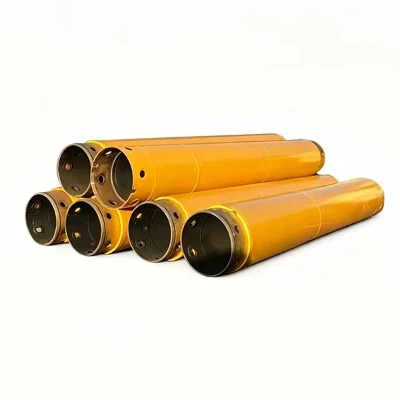
"Rotary cutting bits" is a broad label that covers a lot of very different hardware - flat teeth for soft soil, bullet-shaped tungsten carbide teeth for weathered rock, and roller-cone inserts for solid bedrock. Treating them as interchangeable is where a lot of projects lose time. The bit sitting at the working end of a Kelly bar has to match both the geology below it and the torque being delivered above it, or penetration rate drops no matter how powerful the rig itself is rated.
|
|
In cohesive soil and soft sand, standard flat-tooth rotary cutting bits displace material efficiently without the added drag of carbide teeth that soft ground doesn't need. Once a bore reaches weathered sandstone, shale, or dense cobble, tungsten carbide bullet teeth take over - they're the standard fit for a rock auger paired with an interlocking Kelly bar, where crowd force is transferred directly into the cutting edge. |

Solid bedrock above roughly 30 MPa unconfined compressive strength is a different problem entirely: at that hardness, flighted or bucket-style cutting bits stop being efficient, and the job shifts to roller-cone core barrels that cut an annular ring before breaking the core block. Matching this progression - flat teeth, then carbide bullet teeth, then roller-cone inserts - against actual ground data is the difference between a rig maintaining its rated penetration rate and one grinding to a crawl in strata it wasn't tooled for.
▸
Standard fit for weathered rock and dense cobble on an interlocking Kelly bar.
◆
Reserved for hard bedrock above ~30 MPa, cutting an annular ring before breaking the core.
|
Yuanxian's engineering review looks at bore diameter, drilling depth, and site geological description before recommending a cutting bit type, rather than defaulting every project to the heaviest tooling available. Structural welds on every tooling assembly pass ultrasonic and magnetic particle testing, and a first-year spare parts kit - including replacement teeth - ships alongside the machine so worn bits don't stall a project waiting on parts. |
|
FAQ
Q: How do I know which rotary cutting bit fits my project?
A: It comes down to the geology: flat teeth for soil, tungsten carbide bullet teeth for weathered rock, and roller-cone inserts for hard bedrock above roughly 30 MPa unconfined compressive strength.
Q: Can one rig switch between multiple cutting bit types?
A: Yes, provided the rig has sufficient torque capacity - operators commonly switch bits as a single bore passes from soil into weathered rock and then bedrock.
Q: Are replacement teeth for rotary cutting bits included with the machine?
A: Yuanxian ships a first-year spare parts kit with every machine, including wear keys and replacement teeth, so worn bits can be swapped without waiting on a separate parts order.
The bit at the end of the string does most of the actual work, and matching it correctly against ground conditions is what keeps a rig's rated torque and depth figures meaningful in practice rather than theoretical.