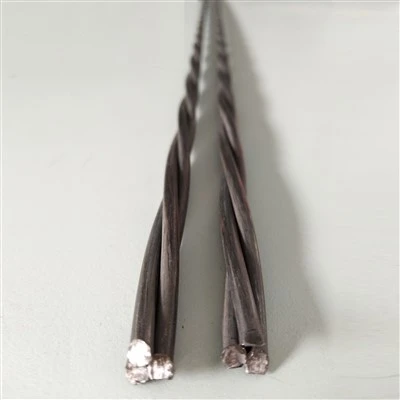

Yuanxian High-tech Material Trading (Tianjin) Co., Ltd. is one of the leading manufacturers and suppliers of unbonded pc strand in China. We provide advanced materials made in China with low price. Welcome to wholesale bulk CE approved unbonded pc strand from our factory. Contact us for customized service and free sample.
Unbonded PC strand takes our standard 7-wire prestressing strand and wraps it in two protective layers - a corrosion-inhibiting grease coat and an extruded HDPE sheathing - so the tendon never bonds to the concrete. Because there is no grout and no duct to install, the tendon can be stressed straight from the coil, laid to any curvature the slab needs, and tensioned after the concrete has hardened.
This page covers the YXXK-UPS series to JG 161-2004 with single-layer HDPE sheathing, with strand steel certified to GB/T 5224-2014, EN 10138 / BS 5896 or ASTM A416 as your drawings require.

What Makes Unbonded Strand Different
No ducts to reserve, no grouting on site
Bonded tendons need steel ducts fixed in the formwork, concrete poured around them, and cement grouting after stressing. Unbonded strand removes all three steps: the sheathed tendon is simply fixed to the reinforcement at the designed profile and stressed once the slab reaches strength. For cast-in-place floor slabs this typically trims days off each floor cycle and eliminates the corrugated-pipe cost entirely.
A grease layer engineered to stay in place
The anti-corrosion grease between strand and sheath is selected for building service life: drop point at or above 160 °C so it will not liquefy in summer heat, workable down to −40 °C without brittleness, cone penetration 265–295 (0.1 mm at 25 °C), and tested for salt spray, humid-heat and oxidation stability. It lubricates the tendon during stressing, blocks moisture for decades and stays chemically neutral to the concrete around it.
HDPE sheath that survives handling and service
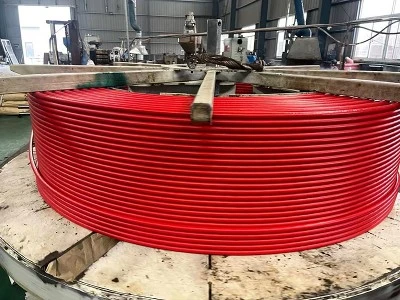
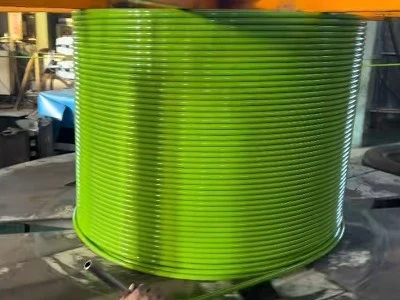
Sheathing extrusion uses HDPE with tensile strength at or above 28 MPa and elongation at break at or above 600%, so the jacket stretches with the coil instead of cracking when payed off or bent around detailing, and environmental stress-crack resistance keeps long-term integrity. Wall thickness is at least 1.0 mm on the standard sizes and 0.8 mm on the 9.5 mm section, extruded to a smooth, even finish with no exposed grease at the coil ends after wrapping.
Friction values your stressing calculations can rely on
Friction is the whole point of a quality unbonded tendon. Ours holds a strand-to-sheath friction coefficient μ of 0.04–0.10 and a wobble (per-metre deviation) coefficient κ of 0.003–0.004, so elongation measured on the jack matches the values in your prestressing loss calculation - fewer surprises during stressing and fewer re-stress calls.
Recoverable anchor cable option for temporary works
For excavation support and other temporary anchorage, the unbonded format allows a recoverable-strand anchor: once the temporary works are no longer needed, the strands can be de-tensioned and pulled out for reuse instead of being grouted in permanently - cutting both the steel cost and the disposal problem on short-life projects.
Sizes & Data (JG 161-2004, Single-Layer HDPE Sheathing)
| Type Code | Steel Strand Dia. | Section Area | Tensile Grade | Min. Grease Coat | Min. Sheath Wall |
|---|---|---|---|---|---|
| YXXK-UPS9 | 9.5 mm | 54.84 mm² | 1860 MPa | 320 g/m | 0.8 mm |
| YXXK-UPS13 | 12.7 mm | 98.71 mm² | 1860 MPa | 430 g/m | 1.0 mm |
| YXXK-UPS13 | 12.9 mm | 100.0 mm² | 1860 MPa | 450 g/m | 1.0 mm |
| YXXK-UPS15 | 15.24 mm | 140.0 mm² | 1860 MPa | 500 g/m | 1.0 mm |
| YXXK-UPS15 | 15.7 mm | 150.0 mm² | 1860 MPa | 530 g/m | 1.0 mm |
Standards behind the table: the finished unbonded tendon follows JG 161-2004; the strand inside is produced and certified to GB/T 5224-2014, EN 10138 / BS 5896 or ASTM A416; the HDPE jacket material follows GB 11116 and GB/T 9341 requirements; and the grease follows JG 3007. Dual-layer (double-sheathing) versions for harsh ground conditions are quoted on request.
Every coil leaves with test records covering strand mechanical values, grease application weight and sheath thickness, so the numbers your design assumes are the numbers the site receives.
Built and Checked, Layer by Layer
Unbonded strand is only as good as its three layers, so each one is controlled separately. The strand steel is drawn from newly produced 82B rod - no rerolled or rusted stock - with the surface cleaned of dust, scale and oil before stranding, and straightness held to a bow height under 2 mm per metre so the sheathed tendon lies flat against the formwork without fighting it. Grease application weight is checked along the coil, and sheath wall thickness is verified at the extruder and again at packing, with the friction coefficients μ and κ confirmed on finished samples rather than assumed from the datasheet.

Where Unbonded Strand Is Specified
Cast-in-place work is the classic territory: PT floor slabs in high-rise and car-park construction, where duct-free tendons keep floor cycles short.
Ground engineering is the second major outlet - foundation piles, slope and excavation support, and recoverable anchor cables for temporary works, where the unbonded format lets the steel come back out when the support is no longer needed.
Because the tendon can be bent to shape on site, it also suits irregular layouts, transfer slabs and retrofit strengthening that bonded duct systems handle poorly.
 |
 |
 |
 |
FAQ
1. Single-layer or double-layer sheathing - which do I need?
Single-layer HDPE to JG 161-2004 covers building slabs and most anchor work. Double-layer sheathing is specified where the tendon sits in aggressive ground, seawater contact or permanent anchors with long design life. Tell us the environment and design life and we will quote the matching construction.
2. Which strand standard should the certificate follow?
Whichever your design cites: the finished tendon is certified to JG 161-2004, and the strand inside can carry a GB/T 5224-2014, EN 10138 / BS 5896 or ASTM A416 certificate with that standard's mechanical values - all from the same production line, mixed in one shipment if needed.
3. Can the tendon really be curved on site?
Yes - that is a core advantage of the unbonded format. The grease and flexible HDPE jacket let the tendon follow any profile the slab design sets out, fixed to the reinforcement with chair supports at the designed spacings. Only the minimum radius and support spacing from your PT supplier's details need to be respected.
4. How is the product packed for export?
Sheathed coils are packed to protect the jacket through ocean freight: wrapped coils with protected ends, UV-safe covering for yard storage, and tags per coil showing type code, strand size, standard, heat number and length. Coil weights are agreed at ordering to suit your unloading equipment, and third-party inspection before loading is welcome.
Need a quotation for unbonded strand? Email the type code (or diameter), standard and tonnage to a.lee@yxmaterial.com, call +86-022-23763704 or message WhatsApp +86 180 2006 1362 - an engineering-backed quotation with current lead time reaches you within one working day.
Hot Tags: unbonded pc strand, China unbonded pc strand manufacturers, factory, cermet guide rollers, concrete anchorage, concrete post tension anchorage, low relaxation pc wire, prestressed concrete strand, TIC rod